Six easy games you can set up in a minute, with the steps, the next level, and when to stop.
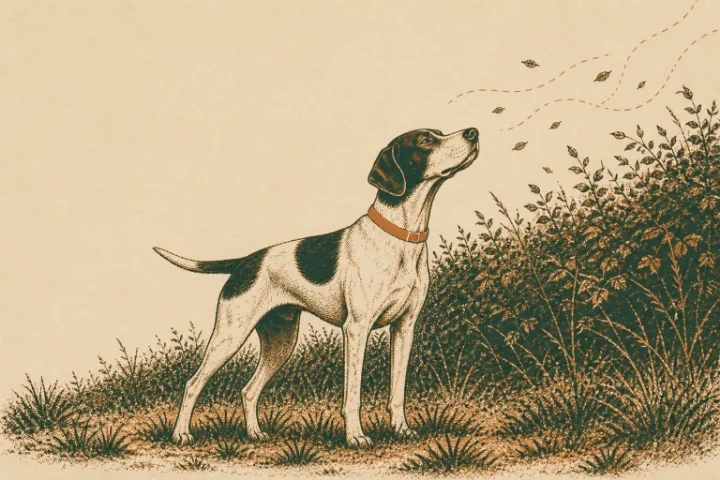
Scent games are short searches where your dog uses their nose to find food or a toy you have hidden. Start with Find It: drop a few treats, say your cue, and let your dog search. When that is easy, hide them out of sight, then add towels, cups, boxes and new rooms. Five minutes is a full session.
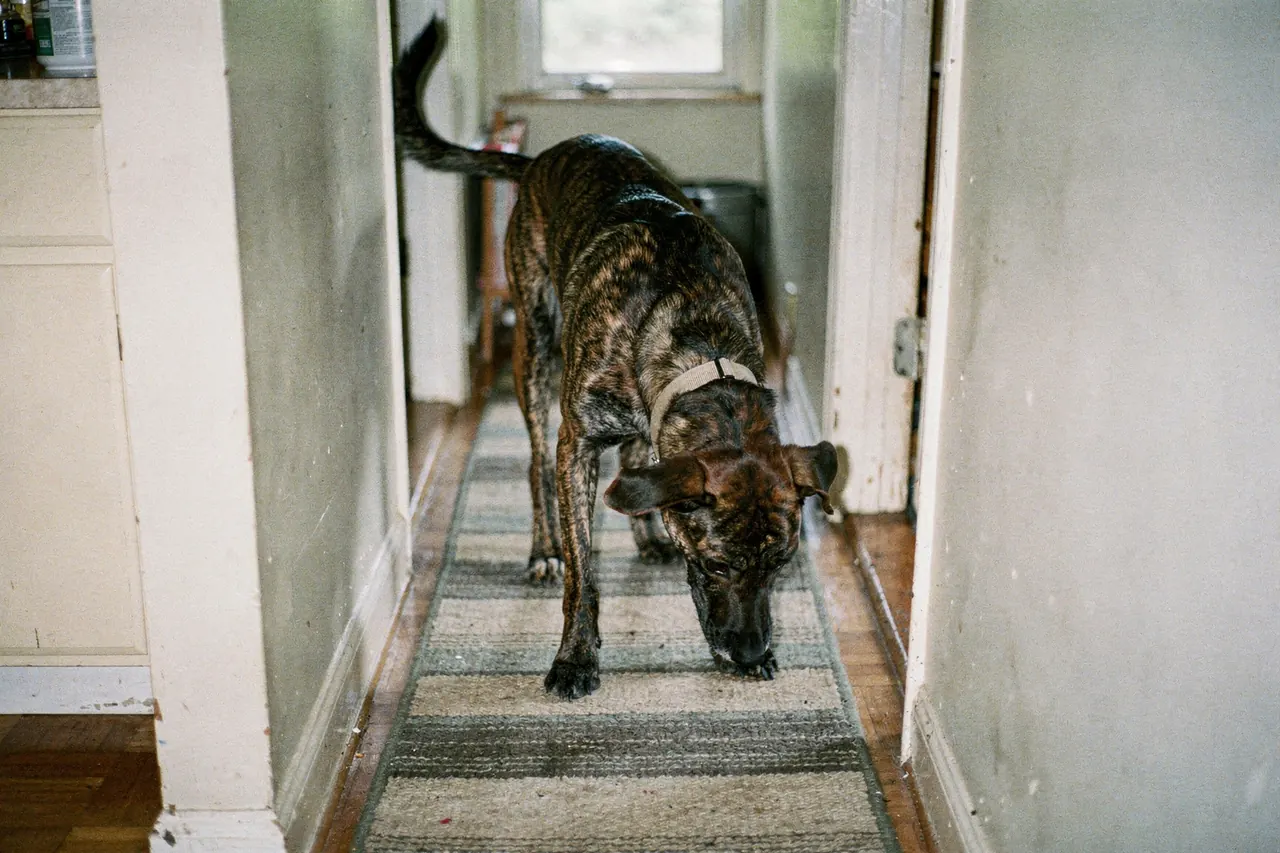
SniffQuest photograph — The hallway is already a search field.
Scent Game Finder
Which scent game should you play today?
The Finder draws from eight games: six indoor guides with full steps on this page, and two outdoor options that open our sniff-walk hub. Answer three quick questions to get one match, with a first step, safety cues, and a link to the full guide.
Your answers stay in the browser and are not saved. Like the rest of SniffQuest, this page loads Google Analytics and Microsoft Clarity, which may set cookies. The Finder itself does not sign you up or store your choices.
Sniffing is one of the main ways dogs gather information, and searching for food is a natural behaviour many pet dogs rarely get to use. Scent games give it an outlet indoors: on rainy days, in small homes, for older dogs, and on evenings when a long walk is not going to happen.
There is some evidence it helps beyond tiring a dog out. In a 2019 study, pet dogs who did two weeks of daily nose work responded more optimistically in a judgement test afterwards, while dogs who practised heelwork did not change (Duranton & Horowitz, 2019). It was a small study, so read it as encouraging rather than proof.
Last reviewed: 2026-10-17
Before you start
Five rules that make every game work
Keep sessions short. Three to five minutes, or two or three rounds. End while your dog still wants another turn.
Make the first finds easy. A beginner should succeed within seconds. Difficulty comes later.
Use one cue and say it once. Then stay quiet and let the nose work. Pointing and helping teach your dog to watch you instead.
Count the food. Use pea-sized pieces or kibble from the day’s ration so games do not add up to extra meals.
One dog at a time. In multi-pet homes, play with each dog separately so nobody has to compete or guard a find.
Six beginner games
Scent games, easiest first
Learn Find It first. Its cue carries into every other game, and out onto walks later.
1. Find It (scatter search)
You need: eight to ten small treats, a clear patch of floor.
Set up: with your dog watching, drop one treat by your feet and say “find it” as they eat it. Repeat three times, then toss treats a little further apart, and finally scatter a handful across the floor.
Make it harder: scatter onto a rug, tuck treats behind chair legs and door edges, then hide them while your dog waits in another room.
Simplify if: your dog looks at you instead of the floor. Go back to dropping treats in plain sight.
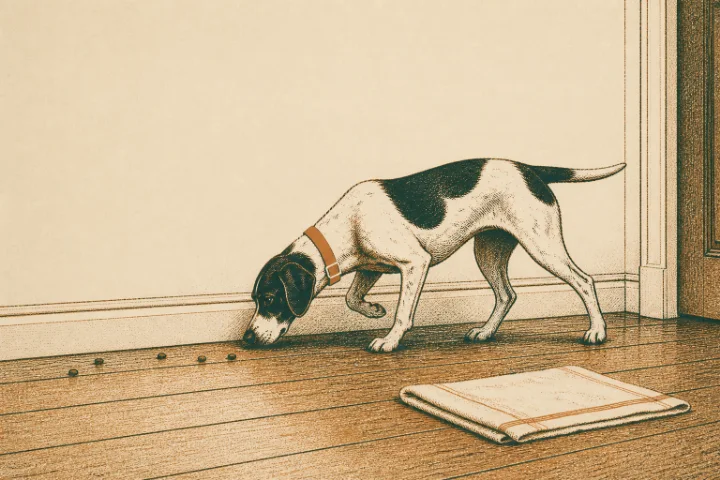
SniffQuest illustration — Level three of Find It: treats along the skirting board, a towel waiting for the next game.
2. Towel roll
You need: an old bath towel, a few treats.
Set up: lay the towel flat, scatter treats across it, and roll it up loosely from one short end. Put it down, say your cue, and let your dog nose and paw it open.
Make it harder: roll it tighter, or tie a single loose knot in the middle once unrolling is easy.
Simplify if: your dog walks away or starts chewing the towel. Unroll it halfway, or just bunch it loosely. Put the towel away after every session. For a slower version, see the snuffle mat and DIY towel guide.
3. Cup game (which one?)
You need: three identical plastic cups or bowls, upside down, and one treat.
Set up: start with one cup. Let your dog watch you put a treat under it, say your cue, and lift the cup the moment they sniff or nudge it. Then use two cups, then three, setting them down while your dog watches.
Make it harder: load the cup out of sight and set the row down; your dog has to sniff along it. Shuffle only once they reliably pick the right one.
Simplify if: your dog knocks every cup over or gets frustrated. Go back to one cup, or use cups with a few holes poked in the base so more scent comes through.
4. Box search
You need: three to five cardboard boxes with tape, staples and labels removed.
Set up: spread the open boxes across the floor and drop a treat in one while your dog watches. Release with your cue. When your dog finds it, reward and reset with a different box.
Make it harder: load the box while your dog is out of the room, fold the flaps in loosely, or add a little scrunched paper on top.
Simplify if: your dog tips boxes over or barks at them. Use fewer, lower boxes. Stop if your dog starts eating cardboard rather than searching.
5. Sniff-and-seek (hide and seek)
You need: a helper, or a sit-stay or a baby gate, plus treats or a favourite toy.
Set up: one person holds your dog’s harness, or your dog waits behind a gate, while the other hides a few treats or the toy in easy spots around one room. Come back, say your cue, and let the search begin. Swap who hides.
Make it harder: spread hides across two rooms, put them at different heights, or have a person hide behind a door so your dog has to find them by scent.
Simplify if: your dog whines or barks while waiting. Make the wait shorter and the hides closer. If waiting is hard for your dog, hide treats before you bring them into the room.
6. Treat trail
You need: ten to fifteen tiny treats and a hallway or a run of floor that turns a corner.
Set up: lay treats about a stride apart in a line, around a corner, ending in a small “jackpot” of three. Start your dog at the first treat and let them follow the line.
Make it harder: space the treats further apart, curve the trail, or lay it on a rug or a patch of grass.
Simplify if: your dog loses the trail. Put the treats closer together and keep the line straight.
Progression
How to make it harder, and when to make it easier
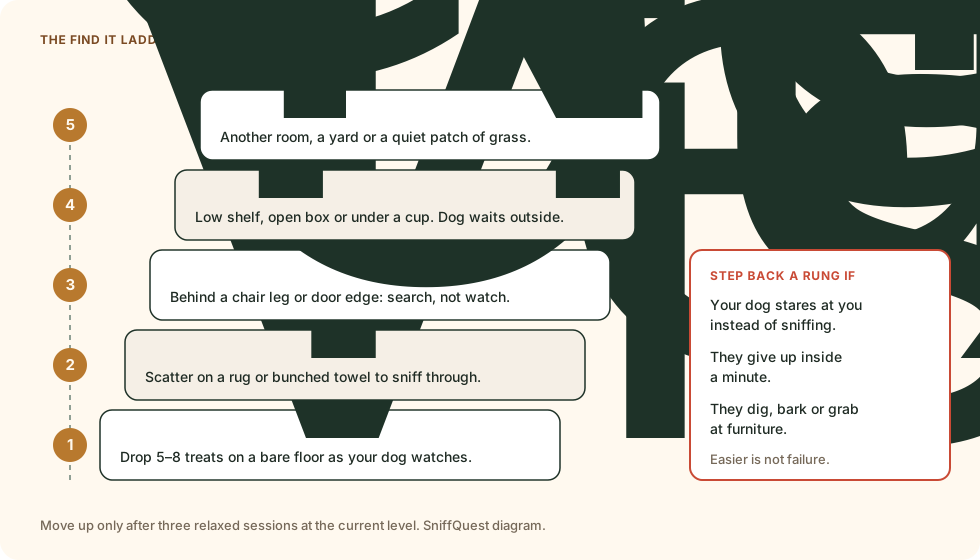
Move up one level only after three relaxed sessions at the level you are on. Changing the room counts as a new level, even if the game itself stays the same.
SniffQuest diagram — One rung at a time. Stepping back a level is part of the game, not a failure.
Stop or simplify when you see
Your dog staring at you or the treat bag instead of sniffing.
Frantic digging, barking, or grabbing at furniture and cushions.
Heavy panting, or a dog who wanders off or lies down mid-search.
Stiffening, growling or guarding when another pet or person comes near a find. Play with that dog alone and talk to a qualified behaviour professional if guarding persists.
Adapting the games
Small spaces and different abilities
Small flats: a single rug, the hallway and furniture legs give you plenty of hides. Use soft treats on carpet or rugs so play stays quiet for neighbours.
Puppies: visible scatter and one-cup games only, for a minute or two. Puppies tire quickly, and easy wins teach them that searching pays.
Older dogs or stiff joints: play on non-slip flooring, keep hides at nose height so there is no crouching or jumping, and avoid stairs. Scent games suit older dogs well because they work the mind without much running.
Dogs with low vision or hearing loss: the nose still works. Keep the room layout the same, use a touch or hand-signal cue for deaf dogs, and use stronger-smelling treats.
Flat-faced breeds and warm rooms: keep sessions very short, play somewhere cool, and stop if breathing becomes noisy or laboured.
Food allergies or weight plans: use your dog’s own kibble or vet-approved food, counted from the daily ration.
Shy or anxious dogs: stay seated nearby in a quiet room, keep the hides easy, and let your dog set the pace. Some dogs would rather search for a favourite toy than for food.
Common mistakes
What usually goes wrong
Making it hard too soon. If your dog gives up, the game taught them that searching does not pay.
Helping too much. Pointing, repeating the cue and walking over to the hide teach your dog to follow your hands instead of their nose.
Playing until your dog quits. End on a find, while they still want more.
Using foods that are unsafe for dogs as treats. Chocolate, grapes and raisins, onions and anything sweetened with xylitol are all toxic; if your dog eats something toxic, call your vet or the ASPCA Animal Poison Control Center.
Leaving towels, boxes or cups out afterwards as chew toys. Pack the game away so it stays special and nothing gets swallowed.
Curious about scent work as a sport? Organised scent work teaches dogs to find essential-oil odours in sealed containers, a step best learned with a class or club. The AKC’s getting-started guide explains how it works. None of the games here need it.
What to do next
When the games feel easy
Keep the same cue and move one step further: a slower search at home, a nose-led walk outside, or a wider nose-work routine.
Slower searches at home
Use a snuffle mat or a DIY towel version for longer, calmer searches, with the loading levels and safety routine.
Short practice notes—repeat one in the same room, then read the next when the window is rainy again.
Latest note · 2026-05-16
Why damp ground slows a walk
On a damp morning the trail smells louder than it looks. Dogs often slow down not from stubbornness but because the ground is busy with yesterday’s rain. If your arm is tired before your dog’s nose has had thirty…
Affiliate disclosure (standard SniffQuest copy): SniffQuest currently has no active Amazon Associates affiliate links. For flea, tick, parasite-control, medication, or health-related decisions, talk to your veterinarian first.
Nose work, sniff walks and seasonal safety, written to be repeated.